
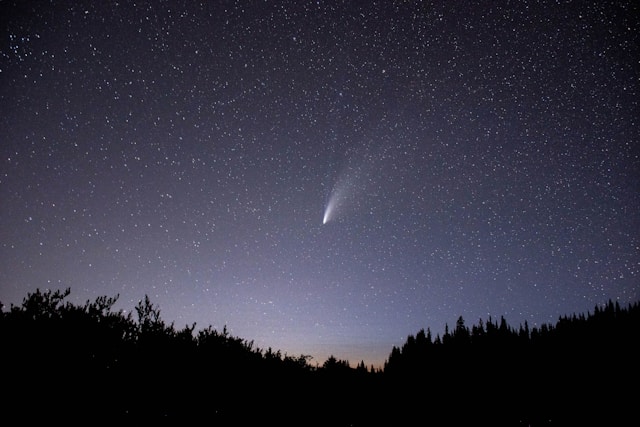
Comets have fascinated humanity for thousands of years. Often described as icy messengers from the outer reaches of the Solar System, they swing into view and vanish again on timeframes that span decades, centuries, or even millennia. A defining feature of many cometary orbits is the aphelion, the farthest point from the Sun. Understanding what happens to comets at aphelion helps astronomers unravel not only their own nature but also the history of our Solar System.
What Is Aphelion in a Comet’s Journey?
Aphelion is the moment when a comet is at the greatest distance from the Sun. For some comets, this can mean just beyond the orbit of Jupiter, while others travel trillions of kilometers into the Oort Cloud. The distinction matters because the farther a comet’s aphelion, the longer it takes to return.
When comets are near aphelion, they are essentially frozen. Outgassing, the release of gas and dust that produces the characteristic coma and tail, ceases because sunlight is too weak to warm their icy surfaces. At this stage, comets are invisible to telescopes on Earth, lying dormant in the depths of space.
Why Comet Aphelions Matter
Studying aphelion is more than just tracking orbital paths. It opens a window into the conditions at the edges of the Solar System. Astronomers believe that many comets formed in the primordial nebula, preserved like time capsules in the Kuiper Belt and Oort Cloud. Their aphelion journeys reflect these origins.
A Glimpse Into the Oort Cloud
The Oort Cloud is a theoretical shell of icy bodies surrounding the Solar System. When a comet’s aphelion lies here, it can remain in darkness for millions of years. Occasionally, gravitational nudges from passing stars alter their paths, sending them sunward. Long-period comets such as Hale-Bopp and Comet West are thought to originate from this distant region.
Short-Period vs. Long-Period Comets
Short-period comets, like Halley’s Comet, have aphelia near the outer planets. They return more frequently, every few decades, making them more predictable. Long-period comets may not return for thousands of years, if ever, because their aphelia stretch deep into the Oort Cloud.
Famous Comets and Their Aphelion Journeys
The study of comet aphelion is enriched by examples of well-documented visitors.
Halley’s Comet
Halley’s Comet has an orbital period of about 76 years. Its aphelion lies beyond Neptune, and during this time it becomes inert, waiting in cold storage before making another dramatic return to Earth’s skies.
Comet Hale-Bopp
Perhaps the brightest comet of the 20th century, Hale-Bopp’s aphelion is in the Oort Cloud, about 370 astronomical units (AU) from the Sun. Its next return is expected in over 2,500 years.
Comet Hyakutake
Hyakutake, which dazzled observers in 1996, has an aphelion distance so vast, over 1,000 AU, that it may not return for 70,000 years. Its journey highlights the immense timescales involved.
How Astronomers Study Aphelion
Direct observation of comets at aphelion is impossible with current technology. Instead, astronomers rely on orbital calculations, modeling, and indirect evidence. Space-based instruments and long-term tracking help refine predictions.
To study these journeys, astronomers:
- Use orbital mechanics to calculate trajectories centuries in advance.
- Compare historical records with present observations to confirm patterns.
- Simulate gravitational influences of planets and passing stars.
- Model the physical behavior of comet nuclei to estimate activity cycles.
These techniques allow scientists to map out aphelion distances and forecast returns, even for comets that vanish for millennia.
The Significance for Science and Culture
Comets at aphelion are not just an astronomical curiosity; they also carry cultural and scientific weight. Ancient civilizations often interpreted them as omens, unaware of their predictable cycles. Today, they serve as tools for exploring planetary formation and the structure of the Solar System.
Cosmic Timekeepers
Because comets preserve primitive ices and dust, they provide clues to the conditions when the Solar System formed 4.6 billion years ago. Their aphelion orbits ensure that this material remains untouched for eons before returning for us to study.
Inspiration for Exploration
Future missions may one day target comets near aphelion to study pristine material. The European Space Agency’s Rosetta mission proved the value of close-up comet science. Extending this approach to long-period comets could answer fundamental questions about the Solar System’s birth.
Looking Forward
Comets remind us of both the fragility and persistence of cosmic objects. Their aphelion journeys stretch beyond human lifespans, reminding us that astronomy is a science measured in generations. Each return of a comet is both a scientific opportunity and a cultural event, linking us to the skywatchers of the past and those of the future.